
IMPORTANT ACTIVITIES - MARSH RELATED
EMEA community, agency, and city meetings and events concerning marsh restoration
5/21/26 Rose Foundation presentation: Edmonds Watershed Restoration Projects
5/11/26 Port of Edmonds presentation
4/14/26 Bill Derry receives award at the Edmonds City Council meeting
4/11/26 2026 Volunteer Fair at the Edmonds Waterfront Center
3/1/26 Marsh orientation for new volunteers
12/16/25 Edmonds City Council discusses taking money from the city’s marsh fund and Marshians speak out
11/23/25 UW WSMP student site visit
11/17/25 Senator Liias meeting
11/14/25 Edmonds, Naturally YouTube channel debuts
10/25/25 Tree planting at the marsh
10/21/25 UW WSMP practicum presentation
9/18/25 Port of Edmonds commissioners
8/23/25 Point Edwards site tour
7/23/25 Parks director
7/8/25 Tulalip tribal biologist
7/1/25 City council presentation, NFWF grant
6/26/25 Point Edwards, 50 Pine presentation
6/18/25 WDFW habitat biologist
6/12/25 Edmonds public market booth
5/29/25 Public meeting
5/14/25 Unocal site tour
4/28/25 Beaver dam camera installation
4/22/25 Alternatives review with city
4/16/25 Parks director
4/1/25 Port director
3/26/25 Current conditions modeling results, public mtg
3/5/25 Workshop #1 planning with city, NFWF grant
3/3/25 Civic Roundtable presentation
2/4/25 Existing conditions review with city
1/31/25 Senator Liias meeting
1/29/25 Washington Department of Ecology, Unocal
10/31/24 Washington Department of Ecology, Unocal
9/26/24 Washington Department of Ecology, Unocal
9/16/24 Washington Department of Ecology, Unocal
8/30/24 City Public Works, NFWF grant
8/24/24 Edmonds public market booth
7/18/24 Marsh tour, Green Drinks
7/4/24 City 4th of July Parade
6/15/24 Edmonds public market booth
3/19/24 City Council grant presentation
2/13/24 Washington Department of Ecology, Unocal
1/29/24 Point Edwards, 50 Pine condos presentation
12/11/23 Port of Edmonds presentation
9/2/23 Edmonds public market booth
8/26/23 Edmonds public market booth
6/21/23 Sierra Club presentation
6/8/23 Mid-Sound Salmon meeting
Finished Art contest
Ongoing Bookmarks
Ongoing Meeting with individual city council members
A spotlight article from My Edmonds News
Scene in Edmonds: Students helping salmon recovery
From December 21, 2022 My Edmonds News
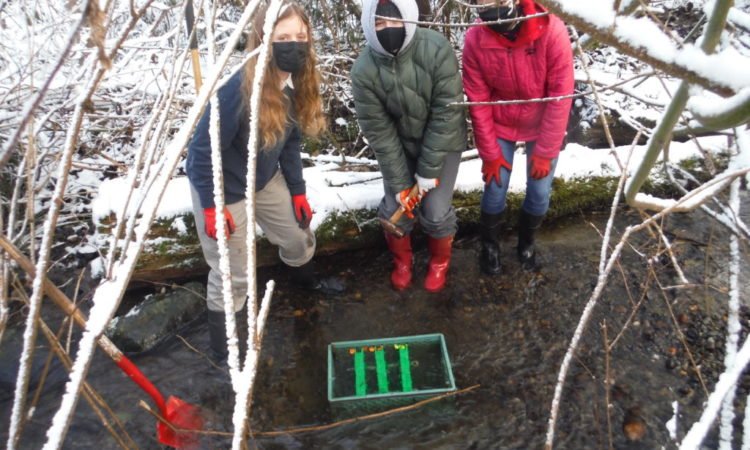
Students from Meadowdale and Edmonds-Woodway high schools came out during their winter break, in spite of the snow and cold, to help the Edmonds Stream Team place coho salmon eggs in hatchboxes (in-stream egg incubators).
Students then installed two of the hatchboxes in Willow Creek near the fish hatchery. Project leader Joe Scordino said the hatchboxes are designed to replicate natural processes in streams but with much greater survival of eggs to fry (free-swimming “baby” salmon). These hatchboxes will also be placed in Shell Creek in coming days.
Another spotlight article from MY EDMONDS NEWS:
The changing seasons at the Edmonds Marsh
— By Bernie Busch from My Edmonds News, December 4, 2022
The day was gray and blustery. The first snow of winter had fallen the day before and more was forecast for the next day. I was on my way to the Edmonds Marsh Estuary with my camera. My mission was to do some photography of the area through the seasons. My photo journaling began unexpectedly as I walked north on the east side of Highway 104. The results of the labor of the many volunteers to free up the flow of water under the highway culvert from Shellabarger Creek amazed me.

Water was flowing freely into the marsh along the west side of the highway. It gave me a glimpse into the possibilities for this sanctuary in the near future. I continued to the northwest side of the area behind the tennis courts along the boardwalk, photographing the wintery scene. It certainly was “fowl” weather.

Even the herons had their heads tucked away from the wind and were not anxious to take flight on this windy day.

Then I came upon the biggest surprise of the day. There at the end of the boardwalk, I discovered two bird-watching telescopes. They were in mint condition and part of a memorial to Bill Anderson and his love of the marsh estuary and the hundreds of birds he had photographed over the years.

And the telescopes work! Don’t ask me how I took this picture with my camera through the telescope.


Hope you enjoyed my journey as much as I did taking it. I’ll be back when the snow creates more photo ops. Thanks for joining me.
— By Bernie Busch
Bernie Busch lives in Edmonds.
Clear and compelling citizen statement advocating and explaining importance of marsh restoration in Edmonds COMPrehensive plan. READ HERE

Dear Supporters of the Edmonds Marsh,
Good news! We are thrilled to announce that the City of Edmonds has been invited to submit a proposal for a National Coastal Resilience Fund grant to define the planning process for reconnecting the Edmonds Marsh to Puget Sound. This is exciting because it moves us a step closer to our goal of restoring the marsh to a functioning estuary, with rearing habitat for salmon, forage fish, and wildlife.
One of the funding criteria is community support. Please help us show that the Edmonds community is firmly behind marsh restoration by reading our EMEA letter of support and signifying your endorsement.
YOU CAN READ THE PROPOSAL IDEA in the PRE-PROPOSAL STATEMENT, HERE.
YOU CAN READ THE EMEA LETTER OF SUPPORT HERE
IF YOU SUPPORT THIS PROJECT AND WANT TO ADD YOUR NAME TO OUR LETTER OF SUPPORT
JUST SEND US AN E-MAIL USING THE CONTACT US PAGE ON THIS WEBSITE. AND THANKS FOR YOUR INTEREST
AND YOUR SUPPORT.
FOR MORE INFORMATION YOU CAN READ THE FAQ, QUESTIONS AND ANSWERS HERE
PAST COMMUNITY ACTIVITIES
Oct. 28th, 2023 -Edmonds Waterfront Center to host Welcoming Figure Awakening Ceremony


Carver Ty Juvenil with Coast Salish Tribal Members Dedicating His Welcoming Figure at the Edmonds Waterfront Center
The Marsh in the News:
Community volunteers dig in to restore Edmonds Marsh
By Joe Scordino Project Leader, Edmonds Stream Team. Posted: September 17, 2022

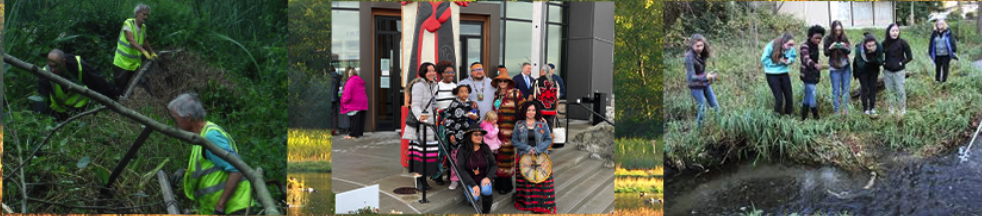
A composite photo of some of the volunteers who worked on the Edmonds Marsh restoration, courtesy of Chris Walton.
After 500 hours of hard labor on 18 days this summer, over 50 community volunteers relished in their success in restoring stream flows in the Edmonds Marsh that had been blocked by chain-link fencing and a huge, spreading mass of an invasive plant called bittersweet nightshade.
This year’s volunteer restoration project, conducted under an Adopt-A-Highway Agreement with the Washington State Department of Transportation (WSDOT), continued last year’s effort to re-establish Shellabarger Creek’s flow into the Edmonds Marsh. Monthly data collected over several years by the Edmonds Stream Team and students from Meadowdale and Edmonds-Woodway High Schools showed that the overgrowth of invasive nightshade had formed thickets in and around the chain-link fencing on both sides of Highway 104 blocking and diverting freshwater flow. The nightshade had also spread throughout the wetland, overwhelming the creek channel and killing trees and other native vegetation.
This summer’s restoration work focused on re-establishing the creek channel on the west side of Highway 104 to complement last year’s successful restoration work on the east side of Highway 104, which re-established a creek channel from the lower end of Shellabarger Creek to the culverts. These culverts, though partially blocked with sediment, are the sole channel for Shellabarger Creek flow to the west side of Highway 104 into the Edmonds Marsh and out to Puget Sound. Prior to the 2021 restoration work, the nightshade-entwined fencing diverted winter stormwater flows in the creek to the Dayton Street intersection, causing flooding.
Community volunteers recognized early on in this restoration project that they could not eradicate all of the invasive nightshade, as it was so pervasive in the wetland. The restoration project instead focused on removing the chain-link fencing (which the nightshade used as an “anchor”) and removing nightshade to the extent possible to maintain open stream channels. The edges of the wetland along Highway 104 were also a priority for nightshade removal to prevent this invasive plant from growing onto and killing trees.
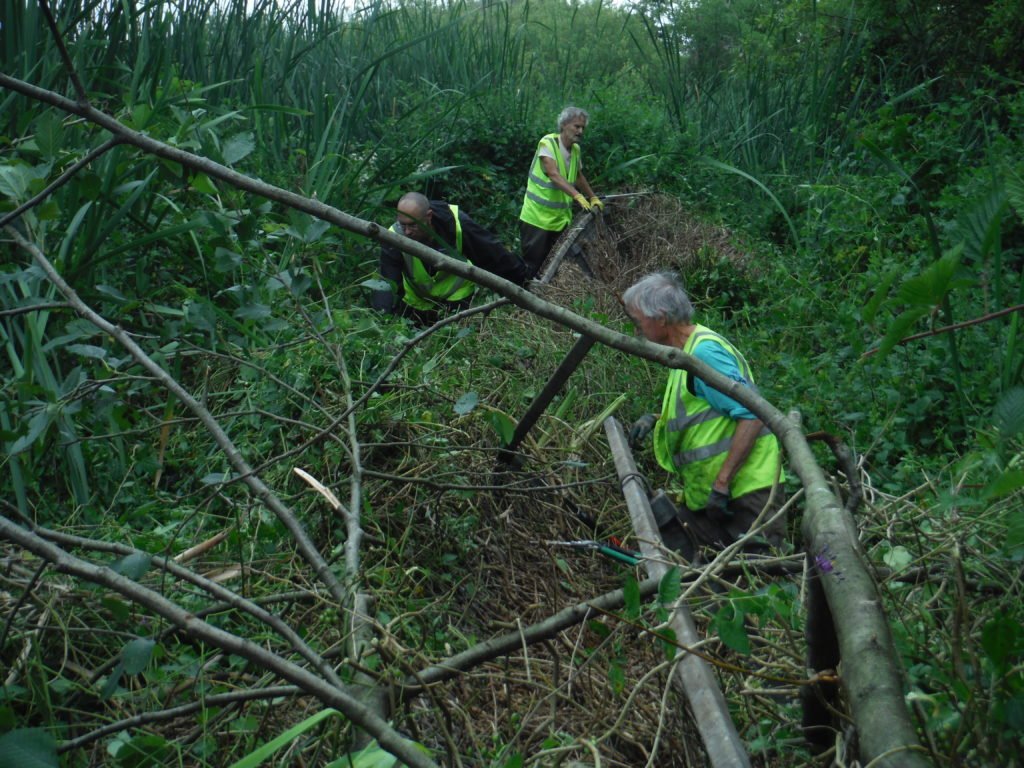
Volunteers also learned quickly the hazards of pulling nightshade roots, only to find themselves waist deep in mud and/or water. Wood pallets (donated by Beacon Building Products and others) became the “bridges” through the wetland so volunteers could transverse the wetland without fear of getting stuck in the mud. Chest-waders, donated by Olympic Fly Fishers, became fashionable attire for working effectively in knee-deep mud and waist-deep water.

After: Shellabarger Creek re-established along banks of Highway 104.
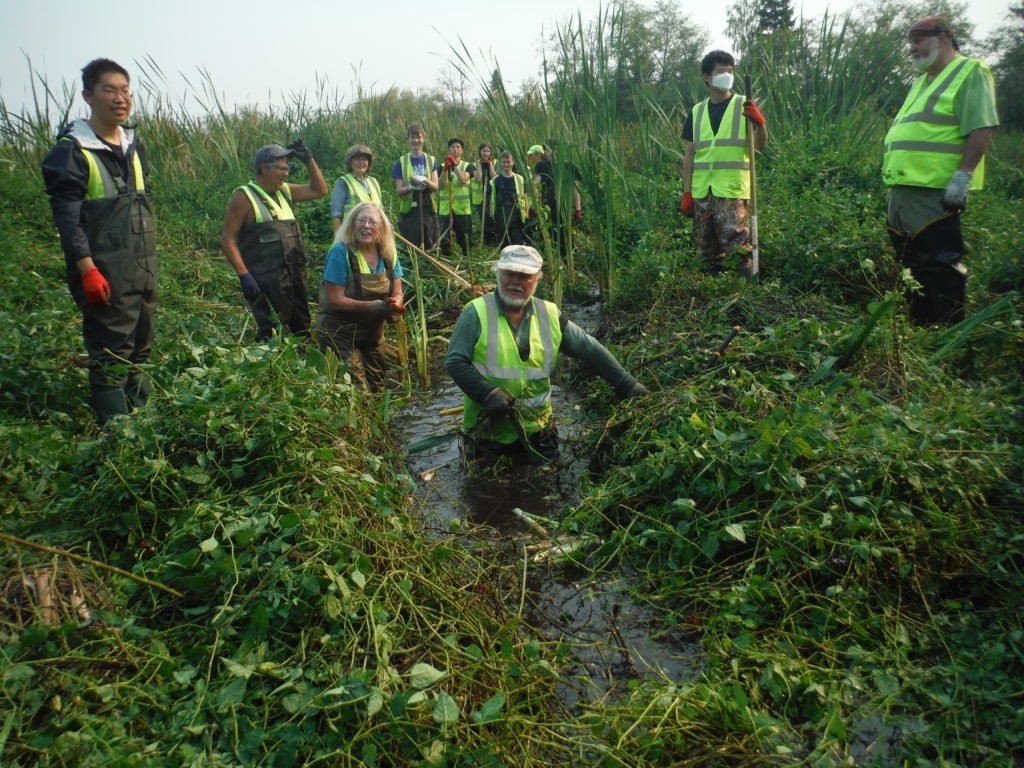
After: Volunteers succeed in re-establishing the creek channel to the middle of the Edmonds Marsh.
Volunteers removing entrenched chain-link fencing. (Photos courtesy Joe Scordino)
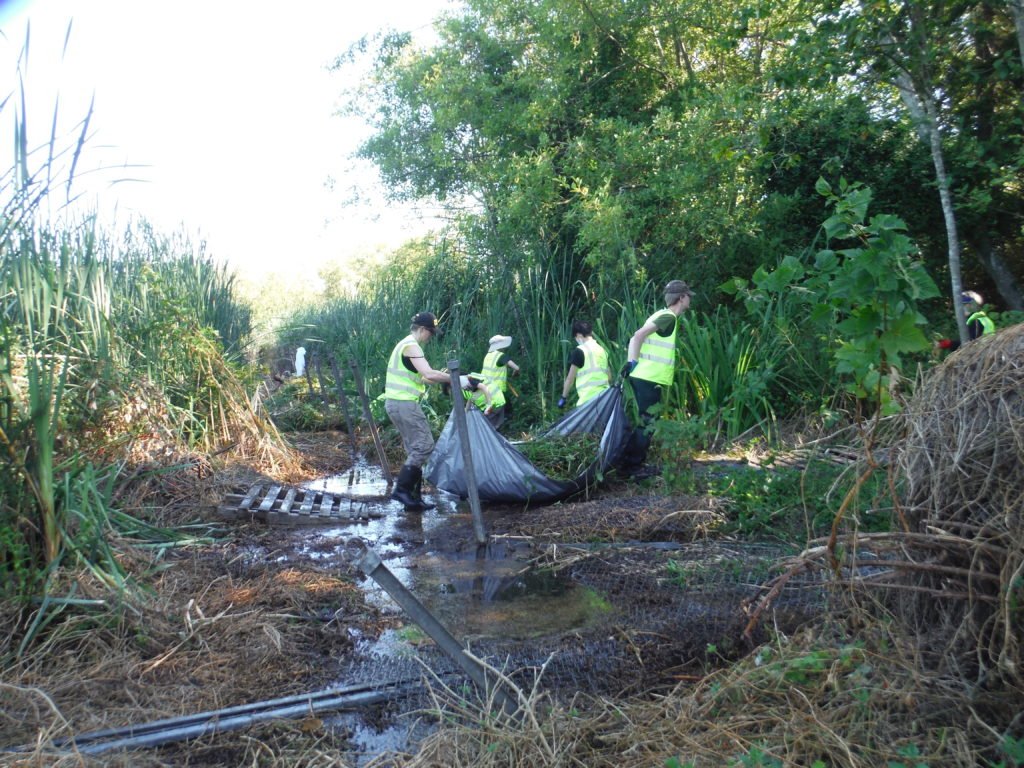
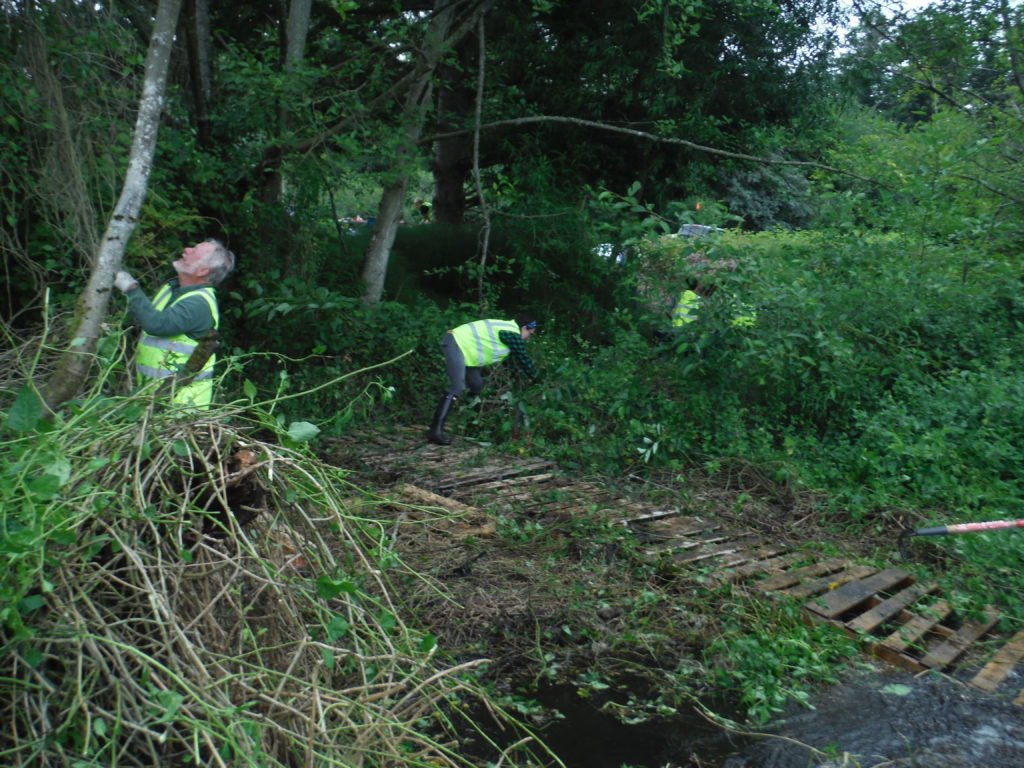
As one of the “regular” volunteers, Selena Bolotin said, “I gained so much from volunteering at the Marsh Restoration project; increased knowledge of the marsh habitat and the negative impact of invasive plants as part of environmental neglect. It was rewarding to see previously stagnant water begin to flow, all in the course of 2 hours of pulling out nightshade plants. The camaraderie of fellow volunteers doing meaningful work made time pass quickly and resulted in seeing quick progress for a seemingly overwhelming task. Having student volunteers involved was particularly brilliant, as they learn scientific tools and knowledge and how to leverage community advocacy — an outdoor schooling that will serve us all in the future.”
Another goal of the restoration project this year was to find and re-establish the Shellabarger Creek channel going west into the estuary and/or connecting to Willow Creek. Although aerial maps and city contractor reports alluded to a creek channel going west from the culverts under Highway 104, no such channel could be found in that area. Finally, in early August, volunteer John Brock noticed a westward water flow as he pulled nightshade roots at the south end of the restoration work site (far south of the culverts). Once this westward creek channel had been found, the last weeks of nightshade removal focused on opening up Shellabarger Creek as far west as possible. Although volunteers made significant progress in opening the creek well into the marsh, the season end date arrived before they could find the Willow Creek/estuary connection. So, that work will have to wait until next summer unless the creek opens up the last of the channel “on its own” during heavy winter rain flows.
All in all, volunteers were successful in re-establishing the Shellabarger Creek channel on both sides of Highway 104 and westward into Marsh. This will provide huge benefits to the functionality of the marsh ecosystem and benefit the wildlife and birdwatchers that frequent the Edmonds Marsh-Estuary. The Edmonds Marsh-Estuary has deteriorated due to both lack of daily tidal exchange and freshwater circulation. With the city finally agreeing to leave the tide gate open year-round (which started in October of 2020) and the diligent work of community volunteers to enhance freshwater circulation and surrounding trees, we are well on our way to bringing back salmon to the marsh and its creeks once the tidal connection is opened across the old Unocal property and Marina Beach.
Many thanks to WSDOT and all the volunteers who helped to prove that community volunteers can successfully restore our natural environment without draining taxpayer funds for expensive consultants (who don’t have on-the-ground or local knowledge, nor the persistence of community members). As the saying goes “Where there is a will – there is a way.”
Marsh restoration volunteers were Aiden Curran, Amelie Mederios, Andy Chin, Barbara Ford, Bernie Zavala, William Alexander, Bob Mooney, Chris Walton, Diane Buckshnis, Isis Liaw, Joe Scordino, John Brock, Joshua Ly, Karen Andres, Kenneth Schultz, Lars Andres, Laszlo Rosman, Lorraine Monroe, Makana Apio, Nancy Scordino, Nathan Zeon, Scot Simpson, Selena Bolotin, Teresa Schultz, Valerie Rosman, Vivian Olson, Alessandra Serafini, Anna Berge, Annabelle Yenter, Benten Taing, Elizabeth Fleming, Bob Seidensticker, Christopher Konkel, Dave Millette, Evan Grey, Greg Ferguson, Jane O’Dell, Kai Rosman, Kathy Jones, Lucia Brady, Maria Metler, Marjie Fields, Matthew Jack, Noah Croskey, Piper Hanson, Russel Jack, Tauri Senn, Vance Ekrem, Waylisha Grey, and Yvette Osai.
— By Joe Scordino
Project Leader, Edmonds Stream Team